Token holder agreements and reporting
Token holder rights
There are two classes of token holders:
Users
Investors
User
Token holder user is a smart contract entity, currently only available to users located in supported jurisdictions.
Token holder user are not required for AML/KYC and wallet address whitelisting.
The legal relationship is governed by General Terms and Conditions and applicable laws with limited legal recourse.
Token holder user will indirectly participate in the performance (Economic exposure) of the underlying.
Token issuers undertakes to use funds for investment in underlying
No right to convert tokens
Token issuer subject to anti-fraud/anti-scam laws
Token holder entitled to share of underlying assets in case of liquidation
Tokenholder rights analogous to structured product or LP in fund
No restrictions on transferability
No trust, fiduciary, or beneficial ownership relationship
Deposits and withdraws crypto
Investor
Token holder investor is a legal person and a PI or Accredited investors based on respective jurisdictions (for example a natural person or corporation). Currently only available to users located in supported jurisdictions.
Token holder investor must undergo AML/KYC and wallet address whitelisting.
The legal relationship is governed by legal contract addendum and General Terms & Conditions with strong legal recourse.
Token holder user will directly participate in the performance (Economic exposure) of the underlying
Strong legal recourse
Investors have the legal right to convert tokens to cash
Token holders have creditor rights against token issuer include right to force involuntary administration
Legal right enforceable via arbitration award through international recognized arbitration panel
Token issuer subject to anti-fraud/anti-scam laws
Token holder entitled to share of underlying assets in case of liquidation
No restrictions on transferability
No trust, fiduciary, or beneficial ownership relationship
Liquidation rights
The intention is that in case of liquidation of the fund that both users and investors have equal rights. We have written the terms and conditions so that users will become creditors of the fund on equal terms with the investors if the fund goes into liquidation. However, should the fund go into liquidation, the final distributions of assets will be subject to the administration process.
Bankruptcy remote
We have set up our legal structure with the intention that the funds are in an SPV that is legally separate and bankruptcy remote from the operations of the fund. Details on our legal structure are available in the legal documentation.
Deposit options
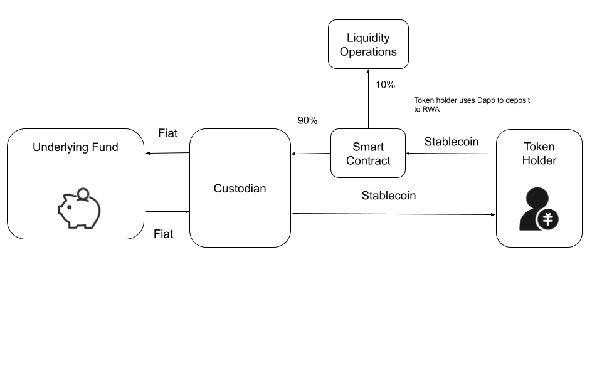
All deposits go through the same path by which the tokens are split into user wallet and underlying
AXC Labs may have a portion of the funds provided for purchase of the underlying to provide instant liquidity. We will provide mechanisms by which holders of the tokens will be able to instantly convert tokens to stablecoins with a discount. The mechanism by which we intended to provide additional liquidity
We will set aside liquidity to redeem shares either through secondary Defi markets
We will arrange with the underlying fund facilities to perform instantaneous buybacks at a discount

Withdrawal options
AXC provides the following two option for withdrawing holdings
| Standard withdrawal to stablecoin | Instant exit to stablecoin | |
|---|---|---|
| Clients | Available to token holders undergoing AML/KYC | Token addresses checked against standard black lists |
| Speed | Two months | One day |
| Availability to clients | Issuer obligated to provide this mechanism to vetted holders | No obligation to redeem. Maybe unavailable due to market conditions |
| Schedule | Exit is available only once a quarter | No schedule limits but may be unavailable due to market conditions |
| Price | Tokens redeemed at NAV calculated by the underlying manager | No obligation to provide tokens at price. May be redeemed at substantial haircut due to market conditions. |
The following chart illustrates the operational flows for deposit and or withdrawal requests:
Timelines for deposit
The deposits are based on a monthly deposit period. For in this example we will begin with a deposit period in January
Deposit period opens: Jan 1st - January subscription period begins. Users submit purchase requests (e.g., subscribe for $10k, initial default $1k = 10 shares).
Payment Completion: Must be completed by Jan 15th.
Earnings Calculation Begins: Starts Feb 1st (next month), using $1k default NAV. No earnings for remaining days in Jan.
Monthly NAV Calculation & Disclosure: Calculated from Mar 1st, disclosed by Mar 20th. If 1% return, Feb NAV = $1010. User sees earnings for the first time here.
Timelines for standard withdrawal to stablecoin
Standard exit requests processed only on Jan 1st, Apr 1st, Jul 1st, Oct 1st each year.
AXC Prepares withdrawal Request: Apr window needs 60 business days notice (Jan 6th). AXC can initiate early, then adjust/cancel closer to April based on user request.
User Submits withdrawal Request: Jan purchasers can request redemption as early as Feb 1st, latest Mar 28th, to meet Apr 1st window.
Await Quarterly Processing Window: Regardless of submission time, processing starts in April (1st of the quarter).
Calculate & Lock Settlement Price: Apr 1st processing uses March NAV as final settlement price.
Confirm Monthly NAV: Around Apr 20th, March NAV calculation complete (assuming 1% return, March NAV = $1020.1). Actual redemption amount known, funds processed.
Funds Received: Within ~15 calendar days after March NAV confirmation.
Token holder reporting
In order to provide the token holder with the information to make investment decisions, the token issuer provides regular attestation reports to token holders regarding the assets held by the token issuer. The token attestation reports contain three information elements:
Tokens which have been issued
Assets held by the token holder
Valuation of the assets held by the token holder
The information for the reports can be taken from on-chain and off-chain sources. On-chain information can immediately be read from the blockchain. Off chain sources require information from third parties whose supporting documents will be available to token holding. The latency on the information of assets held by the token issuer will be provided by custodians and can be provided within T+5 business days of subscription and redemption dates. Information on the valuation of off-chain assets may take longer to process and may be delayed to T+45 business days.